Comparison table
Scroll sideways to see all columns
| Range | Best job / palette | Preparation | Main drawback |
|---|---|---|---|
| Vallejo Model Air | Vehicles, armor, scale-model and military colors | Made for direct airbrush use; some painters thin it further for multiple light coats | Palette leans toward scale modeling rather than fantasy armies |
| Vallejo Game Air | Fantasy, wargames, sci-fi miniatures | Airbrush-ready; thinning helps with very fine nozzles | Current metallics and fluorescents are in Game Color, not Game Air |
| Army Painter Warpaints Air | Beginners building a first full palette | Pre-thinned; shake well; Airbrush Medium adjusts flow | Opacity varies by color, so some colors need more coats |
| Monument Pro Acryl (standard) | Painters who want one paint for brush and airbrush | Usually needs thinning for the airbrush; varies by color | No single fixed dilution that works for every bottle |
| AMMO ATOM | Brush and airbrush use with a dedicated thinner system | Thin with ATOM Thinner or ATOM Retarder Thinner | Keep its matching thinner in the budget |
| Vallejo Model Color (reuse) | Using paints you already own | Must be reduced before spraying | More preparation than a dedicated airbrush formulation |
Airbrush-ready paint vs regular brush paint
Can you airbrush regular miniature paint? Yes, with preparation. Many standard brush acrylics will spray once you thin them properly, but how well they behave depends on the brand, the specific color, and how carefully you thin. A paint that brushes beautifully can sputter or clog in a small nozzle.
“Air” ranges are formulated with finely ground pigment and a lower viscosity, so they flow through small nozzles with less fiddling. That consistency is the real reason to buy them. You spend less time mixing and more time painting. They work well for base coats, smooth transitions, and filters.
Regular brush paint is the budget path, not the wrong path. If you already own a decent collection, try thinning a few bottles before you replace them.
Use the paint thinning steps to test a regular brush paint before buying another collection.
Primer is not color paint
A primer and a base color do different jobs. A primer is formulated to bond to bare plastic, resin, or metal and give later layers something to grip. A color paint, even an airbrush-ready one, is designed to go on top of that surface.
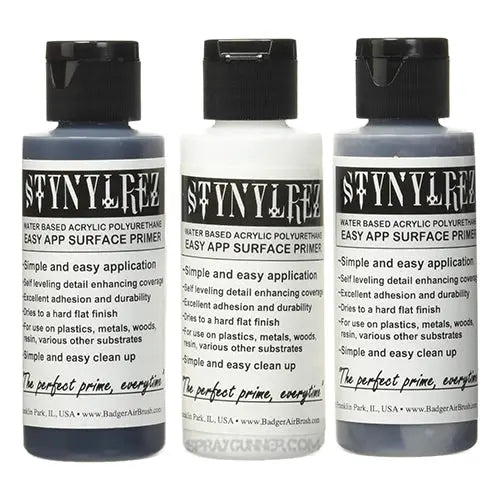
Of the options here, only the Warpaints Air Starter Set includes a dedicated airbrush primer. If you buy Model Air, Game Air, Pro Acryl, or ATOM, budget for a separate primer that suits your airbrush setup.
The primer comparison covers the separate undercoat and how the formulas differ.
Opaque base coats vs transparent effects
Think about what each bottle is for. Opaque colors cover the primer and set the main color of the model. Transparent effects, such as filters and glazes, tint or shift a color you’ve already laid down without hiding it. Airbrush paints handle both jobs, but no paint does both equally well straight from the bottle. To get a translucent effect, you usually thin the paint more, or use a color that’s naturally less opaque. When choosing a range, opacity matters most for your base color, and a smooth flow matters most for transitions.
Some colors cover worse than others because of their pigments. A yellow may need more passes than a dark blue or grey. Plan for a few thin coats instead of one heavy one.
The six choices in detail
Vallejo Model Air
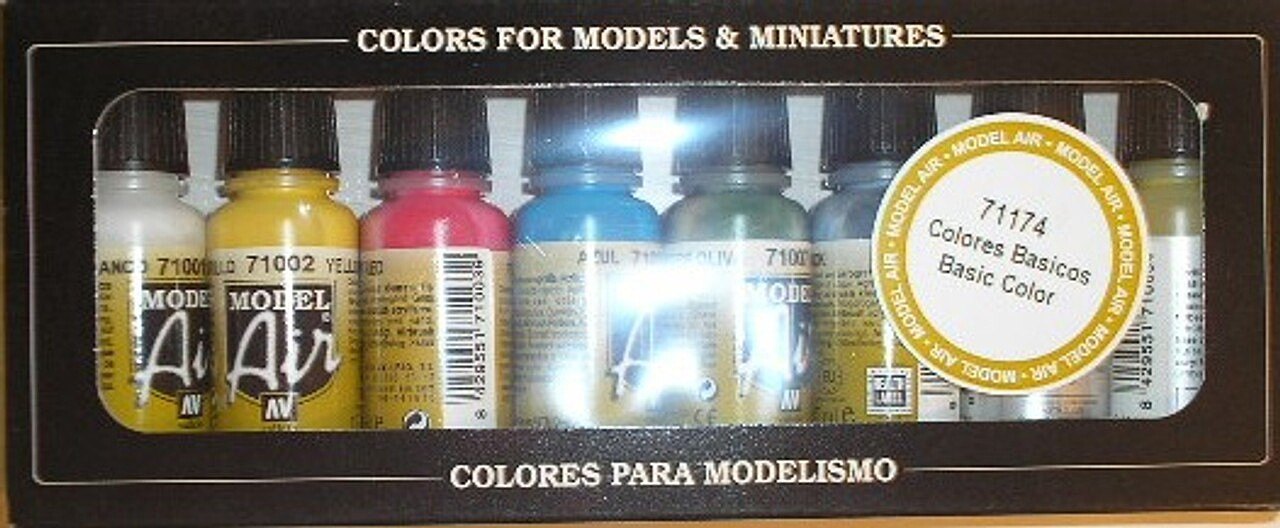
Model Air is a low-viscosity, water-based acrylic designed specifically for airbrushing. Its palette is built around scale-model subjects such as vehicles, aircraft, and military finishes. That makes it a natural fit for tanks, Imperial Guard armor, mech armies, and anything with camouflage. It can also handle small details with a conventional brush.
Model Air is ready to spray, but some painters prefer to thin it a little more and build up several light layers. Vallejo’s own Airbrush Thinner is the matching product for that. The Model Air Basic Colors set (71.174) contains eight colors and is a reasonable starter if your army leans military.
The limitation is the palette. If you paint bright fantasy armies, you’ll be mixing or buying around Model Air’s scale-model focus.
Vallejo Game Air
Game Air is the most direct answer to “airbrush paint for Warhammer.” It’s a matte, water-based acrylic designed for fantasy, wargames, and sci-fi figures, and you can use it with a brush or an airbrush. It has corresponding Game Color shades for brushwork, which is useful for touch-ups and details. Test the dried finish on a spare piece before touching up a large panel. The range follows a Base, Shadow, and Light grouping, which makes it easier to pick three related colors for a single area.
Model Air vs Game Air: both are Vallejo water-based airbrush acrylics. The difference is mostly the palette. Model Air targets scale-model and military colors, while Game Air targets fantasy and sci-fi miniatures and pairs with Game Color for brushing. If you’re working with very fine nozzles (0.2 mm or smaller), Vallejo recommends thinning Game Air.
The catch is metallics. Current metallic and fluorescent colors sit in Game Color, not Game Air, so armor and glow effects need another source.
Army Painter Warpaints Air
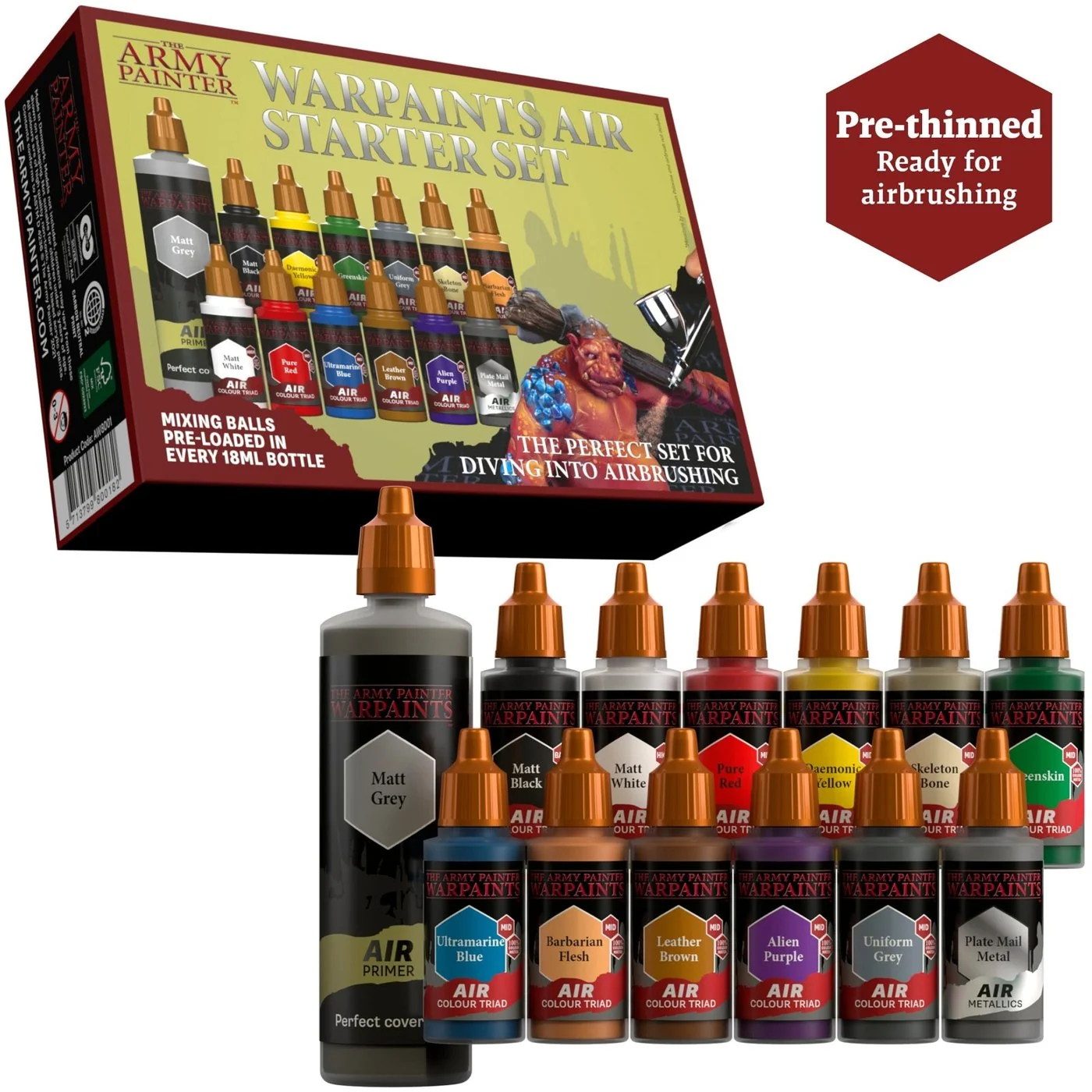
Warpaints Air is a separate formula from Warpaints Fanatic and Speedpaint. It’s pre-thinned for the airbrush. The Warpaints Air Starter Set includes twelve 18 ml colors, one 100 ml airbrush primer, and mixing balls. Shake each bottle for about 30 seconds before use. If the flow isn’t quite right, Army Painter’s Airbrush Medium can adjust it.
Of the two starter paint sets discussed here, this is the one to choose if you want a primer in the same box. The twelve colors still need to suit your army.
Coverage varies across the range, so a yellow will not necessarily cover like a blue. If your army’s main color is one of the weaker covering shades, expect extra coats.
Monument Pro Acryl (standard range)
Standard Pro Acryl is a matte, high-pigment-density acrylic sold for both brush and airbrush. It comes in 22 ml bottles with a mixing agitator inside. Its appeal is that you only need one paint for both tools. That’s useful if you mostly brush and only occasionally spray base coats.
Being a standard paint is also its drawback. It isn’t a pre-thinned Air line, there’s no single dilution that works for every color, and you shouldn’t assume each bottle will spray straight from the dropper. Expect to thin and test it color by color.
AMMO ATOM
AMMO ATOM is a water-based acrylic in 20 ml bottles, intended for both brush and airbrush. It’s built around its own thinners: ATOM Thinner (20500) and ATOM Retarder Thinner (20501). The retarder version is useful when paint dries too quickly at the nozzle.
ATOM works best as a system. If you choose it, buy the matching thinner as well. Its palette includes standard references such as FS-coded greys, which helps with vehicles and sci-fi armor. Like Pro Acryl, it needs your own thinning judgment rather than a fixed ratio.
Vallejo Model Color (reuse what you own)
Model Color is a brush paint, not Model Air. Sets such as Model Color Basic Colors USA are sometimes mistaken for airbrush sets, but they’re brush-oriented. You can reduce Model Color for airbrush use, but it takes more mixing and testing than any dedicated Air range.
If you already have a lot of it, it’s a perfectly good place to learn. Mix a small batch outside the airbrush and test it before filling the cup.
Build a small kit around your army
Skip the giant case. A starter airbrush kit for one army usually needs:
- A primer suited to your models and color scheme.
- A main base color for the largest area of the army.
- A darker shade of that color for recesses and shadows.
- A lighter shade for zenithal highlights or top-down transitions.
- One secondary color, such as cloth, trim, or armor plates.
- The matching thinner. Add a flow aid or retarder only if you have a specific drying or flow problem.
Some examples:
- Blue power-armor army: Game Air in a base, shadow, and light blue, plus a dedicated primer and a Game Color metallic for brushing trim.
- Tank or Astra Militarum force: Model Air, starting from the eight-color 71.174 set, with a primer and one camo color the set doesn’t include.
- Bright Aeldari or Tau scheme: pick the main color first, then check its opacity. A strong-covering mid-tone under a weaker bright color is often the easiest route.
- Brush-first painter adding an airbrush: Pro Acryl or ATOM in your core army colors, so the same bottle handles spraying and detail work.
Getting started
Shake every bottle thoroughly. Airbrush paint settles, and the separated pigment is a common cause of blotchy coats. Test the spray on a scrap piece or the sprue before pointing at a model. Build up color in thin passes instead of one wet layer. When paint dries on the needle tip, clean it off and continue. If it keeps happening, try thinner or retarder from the same brand.
When moving between ranges, stick to water-based acrylics and their matching thinners. Solvent-based hobby paints exist, but they aren’t the sensible default for a beginner painting minis indoors.
If you are choosing an additive, compare thinner and flow improver rather than adding both by default.
FAQs
What’s the best airbrush paint starter set? If its colors fit your army, the Army Painter Warpaints Air Starter Set is a convenient choice: twelve colors and a 100 ml primer. For a smaller, military-focused start, the eight-color Vallejo Model Air 71.174 set.
Can I use Game Air and Game Color on the same miniature? Yes. Game Air and Game Color are compatible ranges with corresponding shades, so you can spray a base and add details with a brush. Test a touch-up on a spare piece to compare the dried finish.
Do airbrush-ready paints ever need thinning? Sometimes. Fine nozzles, multiple thin layers, and translucent effects can all call for a little more thinner from the same brand.
Should I buy a whole range at once? No. Buy for one army’s palette, learn how those bottles behave, and add colors as you need them.